
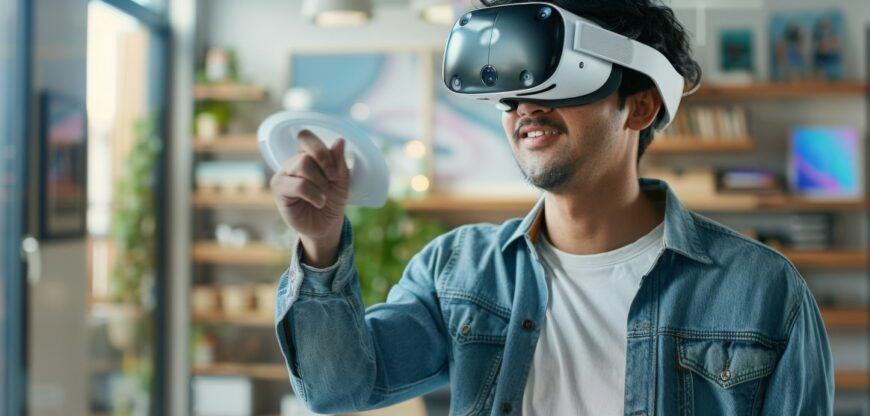
Have you ever considered how the classroom of the future could ever be contained within the pocket of an average pair of glasses? For computer application majors, the journey from coding standard software to the development of an immersed environment is perhaps the most thrilling aspect of the technological revolution.
Augmented Reality and Virtual Reality are not only limited to the world of games; rather, they are ready-to-use platforms that can provide solutions to everyday problems. For an application-oriented degree, being competent in these fields gives individuals the ability to develop platforms that were considered impossible.
Understanding the Immersive Landscape
Before exploring projects, it’s important to understand the difference between these two technologies.
Augmented Reality involves overlaying ‘layers’ like 3D models or information on top of real-world images by means of a screen or lens.
Virtual Reality, on the other hand, involves recreating the entire world that you see by substituting it with virtual images.
Both technologies make use of ‘spatial computing,’ whereby the software detects real-world depth and geometry of the room that it’s in.
Projects and Their Impact for Students
Final year projects and personal portfolios could be distinguished by the emphasis on functionality and accessibility. There are a couple of options for those pursuing technical courses:
• Interactive Educational Tools: Develop an app that makes textbooks come alive. Students can use their smartphone to point at a picture of a complicated machine or biological system and see a three-dimensional image come alive, so they can see inside.
• Virtual Laboratory Simulations: The creation of a VR environment where experiments for chemistry or physics could be conducted is an activity with high value. This activity is particularly useful for activities that are hazardous or costly in nature.
• Retail and Interior Visualisation Develop an application capable of allowing consumers to position pieces of furniture in their room using AR technology. This is an application of AR technology and solves an important issue associated with online retail.
• Navigation & Heritage Guides: Create an AR application for a local college or a local museum. By using the environment, users can be provided historical pieces of information or directions while exploring the environment.
Essential Skills and Best Practices
There is a requirement of creative design aligned with effective programming in these projects to achieve success.
- Optimization is Essential: This is one aspect where mobile devices face severe limitations, specifically on the processing aspect. Optimized models with lower polygons and appropriate textures can be employed in order to deliver smooth functionality with reduced battery usage.
- User Comfort: In VR applications, fast movement can be unpleasant for users. It is essential to design steady transition elements and visual aids for users to get their orientation.
- Choose the Right Framework: Begin by working with known frameworks which provide good surface detection and motion detection libraries to help you avoid having to work on the engine itself.
Conclusion
AR and VR technology is rapidly shifting from a novelty to a necessary business tool. With regard to students, this is a chance to be at the cutting edge of a whole new world, to really stand out in your knowledge of math for 3D, experience, and optimizing code. The world is ready for a new reality. The question is, “what will you build first?”
Recent Posts
- Career Anxiety After Graduation? MCA as a Safe Yet Powerful Choice
- How to contribute to high-impact open-source projects and get noticed
- Quantum computing basics for programmers: What to learn first
- Migrating legacy applications to cloud-native architectures
- Penetration testing automation: Tools and techniques for beginners and intermediates